
Here is a video of the glider flying (10% speed).
I launched it using a catapult made from strands of rubber that I had taken from shock cord. Each strand is about a millimetre in diameter.

Over the years I have tried various hooks for connecting the catapult. The trick is to get it to hook on without slipping, yet detach once the glider is on its way. This one worked well.
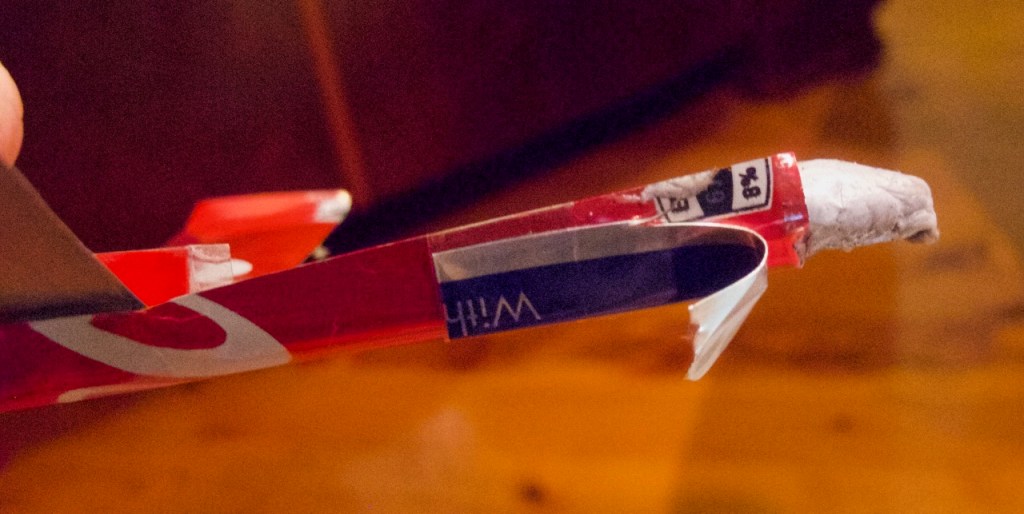
By using the catapult I can get more repeatability
How far will this glider fly?
As best I can tell, the glide angle was about 1:5, that is it travelled 5 m for each metre dropped in height.
The glide angle comes down to how much drag the glider generates in flight.
Drag is the force that slows it down – it’s measured along the direction of the airflow over the glider.
Lift is the force that holds it up. It is measured perpendicular to the air flow (and hence perpendicular to the drag).
What determines how far the glider will fly is the ratio lift/drag.

The angle at which the glider will descend in steady flight is the ratio drag/lift – the reciprocal of the lift/drag ratio. A full size competition sailplane might have a lift/drag ratio of 40 or so – it will fly 40 metres along for each metre down.
I found two references on L/D ratio for small gliders. They show that the aerodynamics becomes unfavourable in small sizes. How the top paper gliders manage 68 m I don’t know.
It looks better at typical model aeroplane sizes – say a wingspan of 46 cm.
What about theory?
If there is no drag, a glider launched horizontally at the right speed will fly horizontally for ever. This is the speed at which lift equals the weight of the glider.

If it is launched a little faster it will climb and descend for ever; a little slower and it will descend first then climb.
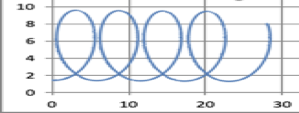
If it is launched much faster it will do a circular loop for ever.
If the glider is launched at the steady gliding speed at the glide angle, lift/drag = 6, (say) from a height of 1.5m (say) it will travel 9 m.
I like to compare the distance it travels with the distance a stone will travel launched at the same speed. Taking the speed as 6.6 m/s, a stone launched horizontally will travel about 3.6 m before it hits the ground. If the height is doubled the glider will travel 18 m and the stone 5.1 m
If the stone is launched at 45 degrees at height 1.5 m and drag is neglected then it will travel 6.2 m.
But a stone can’t loop the loop.
 RhymeAndReason
Fascinating physics!!1 In some misty place i almost understood it!!! The video says it is an improper video!!!
LikeLike
Improper? Surely not me!
LikeLike