
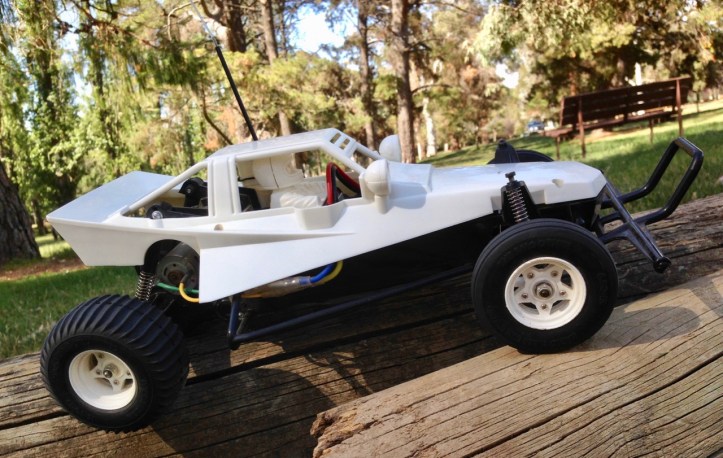
My collaborator in this project has the model car – in Canberra. I live 300 km away in Sydney.
Just a thought. Could a Tesla cover this distance at the ruling speed limits? What about other electric cars? For comparison, our Subaru Forester takes half a tank of petrol.
I’ll use our text messages to describe the tests.
Times cover 10 metres from a standing start running each direction on the Greek church car park: 3.09, 3.12, 3.20. I’ve run the same test a few more times and 3.20 is very consistent.
Now for the same distance at full speed.
Canberra
Neglecting the time to reach steady speed that gives a speed of 3.m/s or 11.3 km/h. It will work out a shade faster when we can get the time after the top speed has been reached.
Sydney
2.20-2.38 is coming up as the predictable range for each direction. This is fun!
Canberra
I make it 14.4 to 16.4 km/h.
Sydney
The last ten passes (5 in each direction) that I’ve done I’ve made sure it was at top speed and I can’t get it under 2.1 and it hasn’t gone over 2.5. I wonder if the battery might be fading a touch now. It was fully charged when I left home.
Canberra
[W]e can find how many revolutions per minute of the drive wheels correspond to your measured car speed.
Sydney
But for this we needed more data
Rear wheel diameter = 82mm.
Gear ratio =14.7:1.
Canberra
This is how the calculation goes
1 rev is Pi*d metres (wheel diameter in metres)
Sydney
so
1 rpm is Pi*d/60 m/s
or
1 rpm is 3.6*Pi*d/60km/h
For your data I got 1100rpm at the road wheel.
Sydney
The gear ratio 14.7 gives a motor speed of 16 165 rpm which seems reasonable.
This calculated motor speed is less than the no-load rpm at 6V supply, which is reassuring!
We don’t know what the actual supply voltage is. The battery claim is 7.2V and 2400mAh, but this is connected to the motor via an electronic speed controller and we don’t know what that supplies.
We can take a moment to see what the no-load speed would be at 7.2V. This is where the mathematical model of the motor comes in handy.
No load speed predicted for 7.2V 22000rpm
Next we’ll find the drag on the model car from rolling resistance, aerodynamic resistance and gravity (climbing hills)
 RhymeAndReason
WOW
LikeLike