
The previous post showed that our chosen motor should make the Grasshopper perform ok. Provided the motor speed is matched to the road speed. What happens if it isn’t?
Just imagine that the motor were connected directly to the road wheels, and the motor was at the rpm for maximum power (9000rpm, say).
The method in model electric car 4: gives
speed = (0.082)*9000*(3.142/60)*3.6 km/h
speed = 139km/h.
That can’t be right! It can’t happen.
We need a device that will take the motor speed as input and provide a reduced speed at output
We need a gearbox.
The output speed of the Grasshopper transmission is 1/14.7 of the input. From the Grasshopper manual, this reduction is achieved in two stages:
- ‘pinion’ on the motor to the ‘counter gear’
- counter gear to ‘spur gear’ on differential
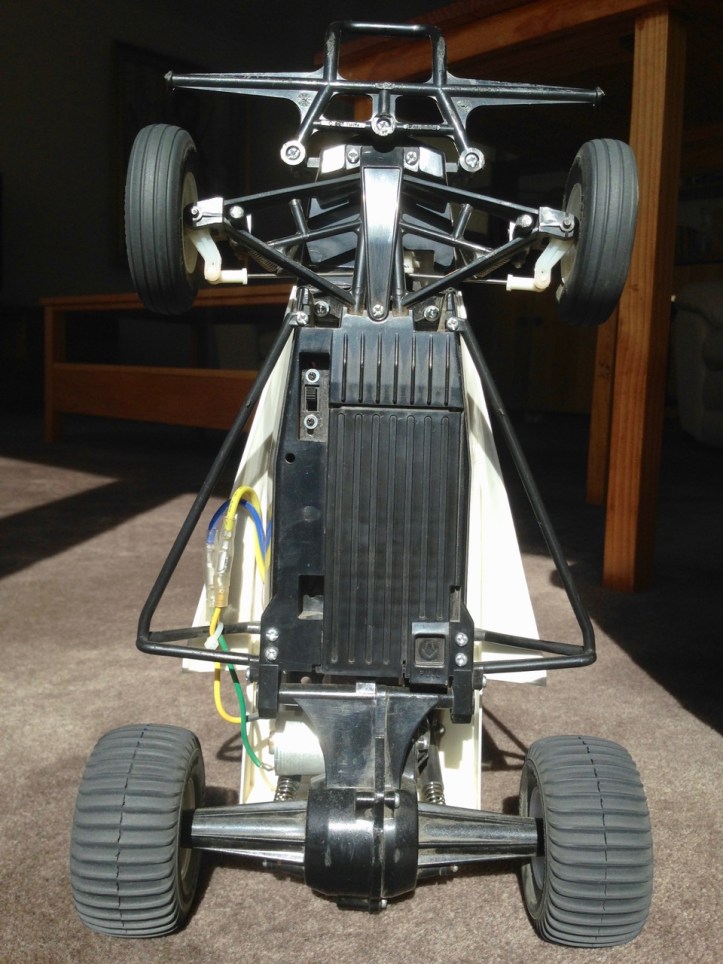
The differential is the unit between the rear (drive) wheels.
Let’s see what happens if we divide the motor speed by 14.7
v = 139/14.7 km/h
v = 9.46 km/h
At no load speed (18000rpm) the speed would be
v = 9.46*(18000/9000) km/h
v = 18.92km/h
this is with a supply voltage of 6V. The battery has a nominal voltage of 7.2V. With this voltage our motor model gives a no-load speed of about 21600rpm, which would give a road speed of 22.7km/h.
Our earlier tests (test series 1) gave a top speed of about 17km/h. We have a discrepancy.
Time for some more tests.
 RhymeAndReason