

I have completed the boat in a rough and ready manner, and have sailed her on a fenced off part of a bay in Sydney’s upper harbour. She reached and ran ok, but struggled to make up to windward, and though most of the time when she healed over she did not take in water, there was one occasion when this happened and, fortunately, I could reach out and pick her up.
I am now finishing her off in a tidier fashion, including adding side decks.
There were other minor problems to do with adjusting the tiller controls, the cut of the jib, and the camber in the mainsail, but all-in-all it was a promising start — a great improvement on the earlier model I sailed in Helston, Cornwall.
But I am getting ahead of myself.
At the end of part 1 I had generated the basic hull shape. The next task was to build the buoyancy compartments in the bow and stern. 
Here’s the beginning of the one in the bow.
To get the deck I cut out a paper template by trial and error, then transferred the shape to a single thickness of aluminium. To stiffen it I folded down the last 5 mm of the aft edge of the deck and folded up the first 5 mm or so of the front edge. Although it did stiffen the deck, it also introduced some strange warping. To fix it I cut into the fold at the aft end of the deck in the middle (see photo) and bent the deck about a longitudinal axis. This worked well; in fact, I liked its funky look.
To maintain this shape, I made a post by folding a single layer of can into a ‘u’ section, which I glued beneath aft end of the deck (it’s green in the photo). When glueing the deck I used fold-back clips to hold the folded part at the front to the top of the transom while the glue dried, and used more fold-back clips to stop the sides from moving while the beads of glue dried there.
The final task on this compartment was to glue the vertical panel in place. Again, I cut a paper template by trial and error and used this template to cut an aluminium one.
I used similar techniques to build the aft deck and buoyancy tank.
Calculations told me that these two buoyancy tanks should be enough to stop it sinking if it capsized. I didn’t test them. Perhaps I wanted to suppress the memories of March days in an English gravel pit sitting in a ‘Graduate’ dinghy with my feet in the freezing water as part of a buoyancy test.
Next I stepped the mast. I made the mast from a length of 5 mm wooden dowel. Provided I could hold it firmly enough at the base, it wouldn’t need shrouds. I made a socket at the base of the mast and added a brace to the fore-deck, as shown in the photo. This worked fine.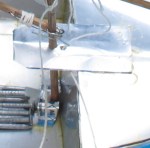
I decided on the fore-aft position by scaling from photos of Mirror dinghies (about 1/3 back from the front transom).
The jib has a boom along its foot to make it self-tacking.
I made the sails from an old pillowcase — made thin by decades of wear. They are not the best, but they got me started.
I connected the main boom to the mast by a ring bent out of a paper clip. You can see this in the earlier photo too.
I laced the mainsail to the mast in the fashion of the original version of the Mirror Dinghy with its gunter lug.
I’ll explain how the boom is controlled after I have described the rudder.
I made the rudder blade from double-thickness can — it’s size was determined from what I had left after making the centre board (see later). 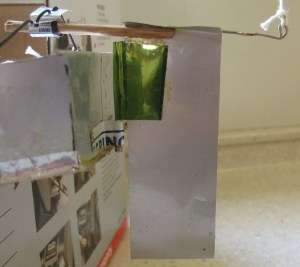 The tiller was another piece of dowel with a vertical slot cut along it at one end (I used a junior hacksaw). I slid the top of the blade into the slot and glued it with my usual glue. I bent the blade at the top as shown to stiffen it.
To get a pivot, I wrapped double-thickness aluminium strip around a nail to give a ‘pintle’, then glued the strip to the bottom of the transom (see photo). I glued a single-thickness aluminium strip around the front of the rudder blade to get a ‘gudgeon’, which I slid over the pintle. 
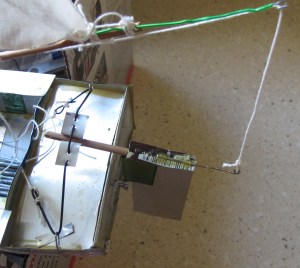 The centreplate was also double thickness aluminium, splayed at one end to give a good glued connection with the hull. I eye-balled the sails and estimated their combined centre of pressure, similarly estimated the centre of pressure of the centre board and aligned the two. I planned to sort out the details on sea trials.
As I mentioned earlier, the first time I sailed her there was a risk that she might sometimes heel too far and take on water. This is unavoidable with an open boat, but to reduce the risk I added side decks. 
These are the main points. You can probably build an aluminium boat from the description so far, but in Part 3 I will add more details on:
- adjustable control lines
- improved sails
- connection of main sheet to tiller rearward extension
- trimming for various points of sailing
- better shapes for rudder blade and centreboard
 RhymeAndReason