
I’ve developed techniques for making model gliders out of aluminium cans. There’s a simple example here.
But I’m a sailor — that’s my wife and me in our Mirror dinghy
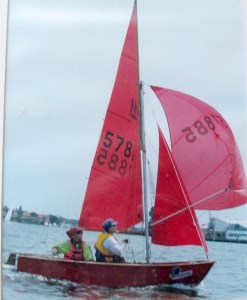
— so it’s not surprising that my next step was to make a toy sailing boat from one or more aluminium cans.
While on holiday in Cornwall I roughed out a proof-of-concept using a soft drink can. I took this photo after we had tried it out on a model boating lake in Helston. It’s worse for wear, and it’s jib is missing, but it did sail (more of less).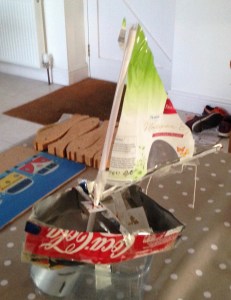
When I returned to Sydney, I started on the next model.
Some years ago I measured our Mirror dinghy so I could make a model of it. I still had the data, and used it to build a frame. I re-assembled the frame for the photo and it is a bit rough, but the first time round I did get the form near enough.
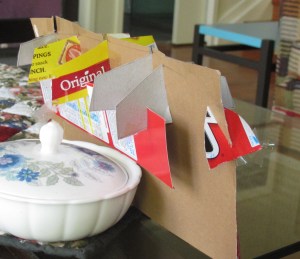
I used paper to represent the plywood panels of the hull — two each side. I cut the paper until it more-or-less fitted the form, took them off the frame then stuck them together with sticky tape along the edges. When I removed them from the frame I had templates for the actual cladding.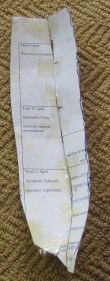
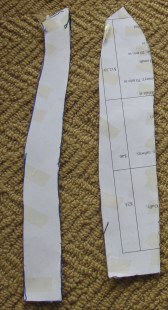
The final cladding would be flat panels made from soft-drink cans and beer cans. I made them as follows. But first a caution: if you try it, take care to avoid cutting yourself on the jagged edges of the aluminium!
The steps are:
1 Cut the top off the can (I used a regular can opener with a rotating disk cutter)
2 Slit down the length of the can with kitchen scissors (Don’t use your family’s best scissors)
3 Cut around the bottom of the can
4 Trim off any parts that are not flat
By this stage you will have a cylinder with a slit down its length. 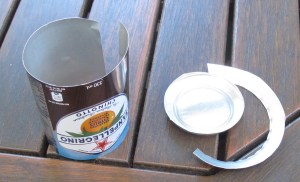
This is what I used to make the Helston demonstrator, but I wanted something better this time. To get a flat sheet I folded the can back on itself like this,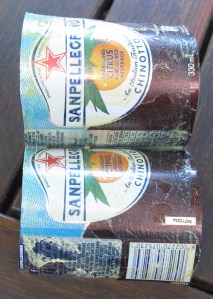 spread contact adhesive on the inner surfaces, waited for it to more-or-less dry then rolled the two inner halves back on themselves until they were together and clamped them with large clips until the glue was secure.
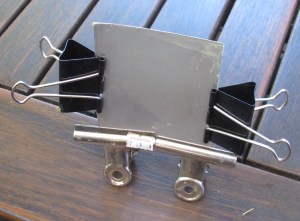
Because the aluminium is impermeable, it’s hard to get the glue to hold permanently – you have to tread the fine line between having the glue too dry (it won’t grab) and not dry enough (it lets go).
I wanted to make this version longer than the demonstrator so I extended the sheets by staggering them so they overlapped them at the ends. I had a 15 mm overlap, but more would have probably been better.
It was time to mark out the panels. I just drew round the edges of the paper templates using a waterproof marking pen. Somehow I must have made the aluminium panels larger than I intended — when I assembled them I got a bigger boat — particularly at the stern. But it should be ok.
I assembled the panels using sticky tape on the outside to hold the shape, as shown in the
photo, 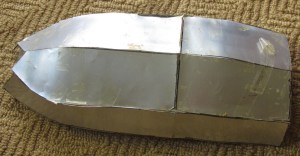 then tacked it together on the inside by gluing little tabs of single thickness aluminium can over the joins. Once I was confident it was right I ran glue lines up the inside of the joins. I let the glue dry, then removed the sticky tape. The next photo shows the tabs and some of the glue.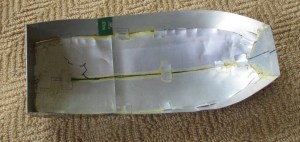
By this stage I’ve got a recognisable boat.
There’s still a lot to do, but I’ll take a break from writing and get on with the making.
 RhymeAndReason