
Paper gliders
I thought model gliders made as below would perform better than a folded paper plane. It didn’t work out that way, but it was fun making them.
You can make a model glider out of an A4 sheet of paper and a drinking straw by following the design drawings below.
Before you start, notice that the dotted outline in the drawing shows where the straw goes – it is not part of the construction.
First cut out the main components.
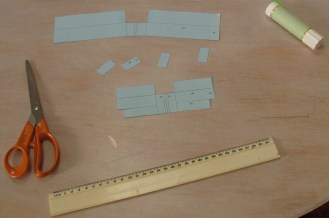
Next fold the front part of each wing back over the back part to give a double thickness.

Then wrap the wings around the straw.
Because the wings are angled back on the sheet, they take up the required “angle of attack” as you swing them forward into a square position.

For a plane to fly, the wing must have an angle of attack. The angle of attack is the angle that the wing makes to the airflow.

Small rectangular pieces of paper are glued on top of the join of the wings, to hold them together.
The tailplane is wrapped round in a similar fashion, but in this case the angle of attack is zero. A single thickness of paper is enough to hold the tailplane together.
The two pieces of the fin are glued together at the same time as the tail plane is glued.
The plane needs ballast at the front to make it fly, so add small pieces of sticky putty (for example) until it flies ok.
And for stability it needs ‘dihedral’ on the wings – the angle that makes the wing tip higher than the root. About 10-15 degrees each side seems to work.
It also helps to bend a little camber into the wing, ie make the cross section convex upwards.
Living in humid Sydney, I find the paper goes soggy and the wings droop. But I just bend them back into my preferred configuration.
The plane can be made to loop as well as glide, but I never got one to fly anything like the 68 metres of the folded paper glider Suzanne.

 RhymeAndReason